
The usual expectation when a slab or wall leaks is that something must be broken open: tiles lifted, screed hacked away, a bathroom put out of use for a week. For many leaks through concrete that disruption is unnecessary. Injecting polyurethane resin into the path the water is taking can seal it from the dry side, with finishes left in place. Understanding PU grouting as a non-destructive repair helps owners judge when it is the appropriate answer and when it is not.
What the Method Involves
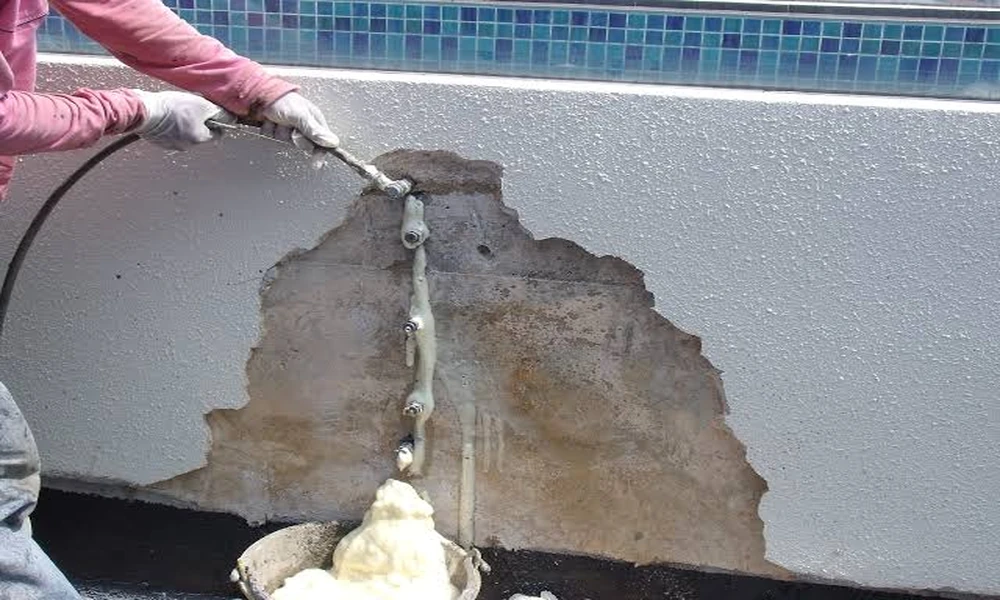
Polyurethane grouting introduces a liquid resin under pressure into cracks, joints or voids within concrete. On meeting moisture the resin reacts, expanding into a foam or gel that fills the passage and bonds to its sides. The work is done through small holes drilled into the concrete near the leak, typically from the underside of a slab or the inner face of a wall. Once the resin has cured, the injection points are removed and the surface patched.
Why It Counts as Non-Destructive
Conventional re-waterproofing requires access to the wet side of the element, which usually means removing whatever covers it. Grouting works from the opposite side. A leaking bathroom floor can be treated from the ceiling of the unit below, and a basement wall from inside the basement. Tiles, fittings and screeds remain untouched. The only marks left are a series of small drill holes, which are filled and can be painted over.
Where It Is Commonly Used
The method suits leaks through reinforced concrete: inter-floor seepage beneath bathrooms and kitchens, cracks in flat roof slabs, construction joints in basements and lift pits, and gaps around pipes that pass through floors. It is also used on water tanks and planter boxes. In each case the common feature is water passing through a defined crack, joint or porous zone in an otherwise sound concrete element.
How the Resin Stops Water
Two broad families of resin are used. Hydrophobic types react with a small amount of water and expand considerably into a rigid or semi-rigid foam, suitable for filling voids and stopping active flow. Hydrophilic types absorb water and form a flexible gel that swells to stay tight in a damp crack. Contractors offering PU grouting as a non-destructive repair select between them according to whether the leak is flowing or merely damp, and whether the crack is likely to move.
The Steps on Site
The technician first traces the line of the crack or the extent of the damp area. Holes are drilled at an angle to intersect the crack within the depth of the slab, and injection packers are fixed into them. Resin is pumped in sequence from one packer to the next until it appears at the adjacent point, indicating that the passage has been filled. After curing, packers are removed, holes sealed and the area monitored.
How Long It Takes
A typical residential job is completed within a day, often in a few hours, and the room above generally remains usable throughout. This compares with several days for hacking, membrane application, curing, screeding and retiling. For occupied homes, shops and offices, the short duration is frequently the deciding factor. It also means a leak can be dealt with quickly, before prolonged dampness begins to affect the reinforcement in the slab.
What Grouting Does Not Do
Injection seals the path that water has found. It does not renew a membrane that has failed across a wide area. If the waterproofing above is generally worn out, water may eventually find another route a short distance away. Nor is it a structural repair; cracks caused by continuing movement or corroding steel need separate assessment. An honest contractor will say so, and will not present grouting as a cure for every leak.
Grouting Compared With Full Re-Waterproofing
The two approaches answer different situations. Where the leak is localised and the remaining waterproofing is serviceable, grouting is quicker, cleaner and far less costly. Where a bathroom is old, the membrane has broken down throughout or a renovation is planned anyway, removing the finishes and laying a new system gives a more lasting result. In some cases grouting is used first to stop the immediate leak, with full renewal scheduled later.
Durability and Warranty
A properly executed injection can last many years, since the cured resin is stable and remains within the concrete, protected from sunlight and wear. Performance depends on correct diagnosis, the right resin and thorough filling of the crack. Warranties are commonly offered on the treated area, and owners should read what is covered. A new leak from a different crack nearby is usually regarded as a separate defect and not a failure of the original work.
Deciding If It Suits Your Leak
Ask the contractor to identify where the water is entering and why, and to explain whether the surrounding waterproofing is otherwise sound. If the problem is a defined crack or joint in an occupied space, PU grouting as a non-destructive repair is often the most proportionate remedy. If the inspection points to widespread membrane failure, be prepared for a larger job. Either way, the decision should follow from the diagnosis, and a written scope and warranty should accompany it.

Comments are closed.